Pages

Showing posts with label energy savings. Show all posts

Monday, April 14, 2014

TOP SHEETS BEGONE: A ZERO-ENERGY WIN/WIN


You know you really don't need them. And, despite the fact that your mom and grandma used them... and even though sets come with them, that doesn’t mean you have to use them. It's a European custom that's time has come. SO, OUT WITH THE TOP SHEETS. You can sleep just as well or better without them. And it can save on energy, too.

Beds in several European countries - if not all - have a duvet, a bottom sheet, but no top sheet. While the European duvet, is a bit thicker and warmer than a top sheet, it’s still usable most of the year. And, it's about the same as making a bed with a spread, light blanket or comforter. So, unless the bedroom is around 90 degrees in summer, a spread or light blanket - preferably cotton or bamboo - or a lightweight comforter is what's called for, anyway.

I know I always need a light blanket because my husband insists on air conditioning in the night. He sweats a lot, even in a room that I find comfortably cool - or cool enough - and says the sweat wakes him up. Anyway, the top sheet almost always could be found kicked down to the very bottom of the mattress or slid totally off the bed - all this making for more clutter and confusion in the early morning.
 
Beyond that, my husband is an above-the-sheets and on-top-of-covers sleeper. He’s that way both summer and winter. As for me, I do my best to stay covered up all night but often find myself half awake, tugging to get back some control of my bed real estate. That’s because my husband, free from all bedclothes restrictions and sleeping soundly, usually traps me in a small space on my side of the bed and with almost all the bed linen pulled under his body. So, sans top sheet, I may still have to contend energetically for bed space and cover but, at least, there’s one thing less to fight over.


Beds without top sheets look just as good.
My awakening to this brighter future happened – in a flash - this past week when I ripped off the top sheet and made the bed without it.  Before, it was a real chore and I did it grudgingly.  I find it easier to make the bed and it looks just as good in less than half the time. Now, I've sworn to always make the bed this way.

So, I've just revived this clutter-busting custom that I did years ago when I lived alone. That leaves me with one less chore in the morning. It's ever so much easier to throw a light comforter or spread over the bed than to actually make it - top sheet and all.

And having less total sheets means more room in my closet. And I do appreciate the extra space. That, since I don't actually have a linen closet but make do with a couple of plastic bins in the master closet. So, I’ve cheerfully given my top sheets to the thrift store to be recycled by someone – who still likes top sheets or even better yet wants to make bottom, fitted sheets out of them or convert them into curtains.

Also, without the added top sheet, more dirty clothes fit into the washer along with the coverlet and pillowcases. And that means water and detergent savings. It also means that you have one item less to fold up before storing it somewhere.

The top-sheet disappearance is a part of my zero-energy campaign – that being, both using less outside energy and also less housekeeping energy. So, to me, at least, living without top sheets is a definite win/win.


Sunday, June 30, 2013

FOUR EASY THINGS TO DO TO MAKE YOUR WASH DAY MORE EARTH-FRIENDLY

You can lower your wash day energy use and your carbon footprint, beginning today, by doing these four Earth-friendly things. And, the best part is that  you won't have to face any big struggle. I've done all this for months and years with great results. And I'm sure my laundry chores don't take much longer or more sweat than those of other people who follow the philosophy: “ I'm doing-what's-easiest-for me.” 

Stop using small to medium-sized plastic detergent bottles
One of the worst things that we've done to ourselves is to embrace the plastic age as if it were some miracle. It's not a miracle. It's a world-wide nightmare producing destruction of wildlife habitats and slowly poisoning everyone of us. The situation is really grave. Some studies show that there’s more plastic than plankton in parts of our oceans. So, reduction of our use of all kinds of plastic is an absolute necessity for both health and the ecology. And one of the worst plastic items that you can buy for home use is the detergent bottle.

Many people are buying small and medium plastic laundry soap containers several times a month. If plastic bags are a bad idea – which they are, those heavier plastic bottles are even worse. What's more, the liquid detergent in those bottles doesn't wash any better than the dry products and takes up a more space, on a wash-by-wash basis. Changing out from plastic detergent bottles to cardboard boxes or large plastic containers is a good place to start. You'll be doing Mother Nature, your own family, and generations-to-come a favor by refusing to buy small, plastic laundry bottles and keeping those items out of the trash, once and for all. And, if you want to, you can buy good laundry detergents in small or medium cardboard boxes. But, if you do industrial-sized laundry during the month, go ahead and buy the largest container - cardboard boxed or plastic - that you can find at the big box store. 

The plastic detergent bottles that you have right now can be easily recycled at home or given away to someone who'll use them. Recycle those huge plastic buckets  for use as a storage container for non-food items like for garden or barbecue tools. If you have some regular-sized plastic detergent bottles, recycle them as clothes pin holders or put small amounts of dry detergent in them so you won't have to carry about or dip into those larger detergent containers for every wash.

Hang some clothes on a line
Line-dried clothes smell better 
There's a big problem with tumble dryers that use electricity to generate heat. They require a lot of electricity and create a huge carbon footprint. How big are we talking about? More than you would imagine. One source says a tumble-dried load produces more than 5 pounds of CO 2 emissions when washed at 40°C. (That, of course, includes the major part that happened at the electric plant.) And, while gas dryers produce somewhat less carbon, the very best thing that can be done is line drying. And line-drying is doable most anywhere on a line or clothes rack. Not ready to hang up all the laundry? Then, start hanging up some part of it. It is super easy to hang up the towels and bed linen on a clothes line. Just doing this faithfully will eliminate several rounds of machine drying and save a lot on energy bills.

And, of course, with the mild to hot weather these days, the very best place is outdoors where the summer sun will dry them fast and leave them with a heavenly meadow-fresh odor. I hang up just about everything in the summer months, eliminating a lot of energy costs and enjoying the sweet smells of of line-dried laundry. Maybe, for some reason, you can't leave clothes hanging outside now or at other times of the year. Even so, you can hang up some lines, in the basement, in the garage or a breezeway and make good use of them. With a little ingenuity, even apartment dwellers can find space to line dry a part of their laundry.

Years ago, when we were kids and the family lived in an apartment, my Mom hung up the linens and towels all winter long in the kitchen to dry overnight. She had Dad hang the lines in such a way that we could walk around the clothes, if necessary. The small items were hung on a wood dowel drying rack near the gas stove in the living room. Most of the time, the laundry did dry by breakfast time. If not, she left them a few more hours. Slightly damp towels could be rehung in the bathroom, awaiting use there. 

While, these days, I don't need to follow closely the steps my Mom took to dry our laundry, I still swear by line drying. Thankfully, now, I have a nice outdoor area where I can hang up clothes and good drying weather almost year-round.

Wash the clothes with cold water
As you can imagine, the higher the water temperature of the wash, the more electricity you'll use. And, hot water wash is not good for clothes or for the ecology. The U.S. Department of Energy says that, in a conventional washer, more than 80% of the energy used for laundry  goes to heat up the water. So, save yourself some money and lower your carbon emission footprint at the same time. It turns out that cold water works great for regular loads. When you have oily or other stubborn stains, try a pre-soak with stronger detergent or stain remover and then use warm water wash.

There are plenty of special, cold water laundry detergents available that can wash your clothes beautifully without hot water. And most modern detergents, including the cheaper ones, work equally well on regular laundry – even if they don't say they're cold water products.

Run the washing machine to its full capacity
You'll get higher wash day efficiency if you load the machine to capacity rather than with just a few clothes. Fill your machine to its limits. For regular loads, you can use your eye to judge when the machine is full. Heavier weight stuff might need to be weighed – to know for sure. Remember, just one large load takes a lot less energy than washing two loads on a lower setting. If you need socks or underwear or a particular shirt for the next morning, wash it out by hand and hang it up somewhere where the air will get to it. It doesn't take long to do.

When I was a child, it was considered “good hygiene” to wash out your own underwear, socks, and handkerchief in the bathroom sink when you prepared for bed. I routinely did this and left the hand wrung-out clothes on a hanger on the back of my bedroom door. They could stay there as long as necessary to finish drying. Our towels were also hung on a towel bar on the back of our doors. Back then, it was considered unsightly to hang a lot of stuff around in the bath room. Although I don't do all of that, today, with just my husband and me at home, I think those habits were more than justified. When I visit in the homes of other people, I continue to do these simple things. And, if my hosts haven't put up hooks on the bedroom door, I hang up my towel and washed out underwear in the closet space that they've left for me. It keeps down on bathroom clutter and helps save on washing machine loads.

Tuesday, September 11, 2012

THINGS TO DOWNSIZE RIGHT AWAY: CASE #1 – LARGE, FLUFFY BATH TOWELS

Even if you haven’t gone through some major economic emergency that has forced you to reduce your former household size, you probably have some kind of plan to downsize and/or take the clutter out of your house. You know - in your heart of hearts - that having all those possessions is getting to be a burden and your soul longs for a lighter material life.

Downsizing seems to be about people's stuff, but it's really about their attitudes and values. And nobody says the process is easy. In fact, many people report a lot of emotional baggage around letting go. We, understandably, tend to identify with our possessions, so downsizing, for any reason, means a confrontation with who we think we are – our very identity. For example, many people with shelves and shelves (and walls) of books say that all those books mean something to them. Can that possibly be true? Of course, not. But their own identity is tied up with trying to be that person who would read all that (and more). You have to let go of that fantasy self and find a new one who says: “I’m only going to live so many more years, and the chances I read or need to look up something in all of these books is close to zero."
It’s the person that has to change. And, beside books, here's a list of other "sticky" possessions that most people find it hard to part with:
Collections of photos, mementos, and family "treasures"
Antiques and favored furniture
Clothing and other “creature comforts”
Stuff they thought they’d use in the future

On the brighter side, and if I’m reading correctly a lot of blog posts, many people report both happiness and relief when they get rid of clutter and downsize. Here's the nitty-gritty  - we all know that it isn’t good to hold on so much to the past, and things are a lot of our past. Too much energy is involved in maintaining all that baggage. And, properly done, we can let go of what we no longer need and create a better future for ourselves. So, I'm challenging you to take that step and make a healthy commitment to look ahead – instead of behind.

At any rate, it isn’t necessary to begin downsizing and reducing clutter with our very most treasured possessions. We can begin elsewhere. There’s a lot to choose from. In this post, I propose just one change that you can do today to declutter and downsize. And it doesn’t have to affect your identity or your creature comfort.

Case # 1 - The Large, Fluffy Bath Towel

Here, I talk about a creature comfort – the bath towel – and how I changed my attitude toward it over the years.
When I was a child, we didn’t have “nice” towels in the bathroom at our house. Well, most of what we had to dry ourselves with after bathing were called bath towels but, clearly, they were leftover items from years of use. My Mom, true to her past in the Great Depression and WWI, was thrifty and didn’t throw towels away until they were literally rags. Then, she used them for rags.
Tending to be small – just big enough for the purpose that they were intended for - our towels were thoroughly wet when you got through drying. That was a fact of life, and, as far as I could tell, no one seemed to worry themselves about it.  The towel, one for each of us, was hung up in the bathroom and used for a week – drying out in the approximate 24 hours between baths. We didn’t have a shower back then. When hair was washed, a second towel, often the dirty one from the week before that was still in the hamper, was brought into action.
Back in those days, regular people - those who weren’t "rich" - made no effort to put out matching towels and wash cloths. Maybe, in the living room or the bedroom, but the idea of bathroom décor just wasn’t heard of.
So, as a child and teenager, I had made comparisons and felt somewhat left out, seeing that our better-off relatives and friends had newer looking and comfier towels. Later, I saw sets of large towels with matching wash cloths in magazines and on the TV. They were ever so large and fluffy. That spelled out luxury to me.  I vowed that, someday, I would have sets of plush  towels and wash cloths that would grace my (dreamed of) large linen closet. And that they would be the heavy, fluffy type. I guess I bought in, big-time, to the media hype of having the "boutique hotel experience."

So, what happened over the years? Well, my husband and I finally got good paying jobs and the cost of cotton items got cheaper, due to foreign trade. Yes, and, for a long time, I prided myself on buying and using large, fluffy bath towels.

Years, later, came a life-changing set of crises – children then on their own, thankfully. At the end of all that, my husband and I were forced to move across country and downsize our living quarters. In the condo that we gave up – the one that I thought would be our retirement home for the rest of our lives - there was a sizeable linen closet and nice bath. So, bathroom decor, including nice towels, was, if not a priority, at least a possibility.

But, from there, my husband and I went to live in just one room in the house of a friend - along with a shared bathroom. So, a lot of downsizing went on. No furniture was taken with us, and only clothing and some personal items made it that far. Of course, I hadn't gotten rid of all of my beloved “creature comforts.” Yes, I had traveled cross-country with four of my largest and most plush bath towels along with matching wash cloths.

Also, at about that time, I began to adopt greener alternatives and started blogging about Earth-friendliness. So, a lot of things came under scrutiny. Those included washing procedures – energy-related things - like always filling up the machine to capacity, using cold water, choosing less harmful detergents, etc. I also found out that cotton, although the products are available to us fairly cheap, have a huge impact on water use and that the people who collect cotton and make the towels do so under terrible working conditions with wages that don’t even feed them well.

That’s about the time I began to look at my fluffy bath towels differently. They took up a lot of space in the closet. They took up too much room in the washer. They didn’t dry as fast as other clothes in the dryer. Also, I had, over the years, lost a lot of my former interest in matching towel sets. Bathroom décor no longer was a priority in my life.
That’s when I decided to change out my old bath towels for smaller, light-weight ones and give my old ones to a local charity. I found a couple of "downsized" towels at the thrift store and purchased another two - half the length and one-quarter the the weight of the older ones. To my surprise the new ones worked fine, and I’m happy enough using them - no regrets. So, now, I’ve solved one volume–related, material problem surrounding bath towels use. And, oh, I'm still working on some of the social and ecological ones.

By the way, I’ve yet to convince my husband. He still has his old towels. Anyway, he’s not likely to buy himself any new towels, and so eventually his towels will be lighter by wear, if not by intent. My pledge is that I’m not buying any larger, fluffy towels for me or for him.

So, this is my take on bath towels. You can get along very well without all those large, fluffy towels. Get rid of them and buy smaller, lighter versions. If you balk at buying more stuff when you already have towels, here’s an idea. Cut those big towels in half and make a pretty crochet edging around the “new” towels. I’ve wanted to that with my husbands’ towels and made my intentions known.  So far, he hasn’t let me do that.

Related posts
HOW CONSUMERISM (STILL) TRIES TO FOOL US
Take steps to use less water
BE SURE TO USE ALTERNATIVES TO CHLORINE BLEACH
Use less energy at home  REDEFINE YOUR PRIORITIES, REMAKE YOUR LIFE
EMBRACE A SIMPLE HOMEREDUCE YOUR CARBON-FOOTPRINT
WHERE TP IS CONCERNED, OBSESSION WITH SOFTNESS = ENVIRONMENTAL DISASTERTRY SWAPPING TO SHRINK YOUR WASTEFUL HABITS (WITH OTHER BENEFITS, TOO.)

Thursday, October 13, 2011

HERE’S TO YOUR GOOD HEALTH IN 2012 & BEYOND!


Well, as we all know, 2012 is just around the corner. So, whether you’re looking forward to it or have been frightened by vague rumblings about great changes - and maybe disasters, our next year on this planet is going to be 2012. So, whatever it may bring - for better or worse - it’s good to get ready. We can do this best by being healthy and helping others to stay well, too. And that advice is good for any year to come. Here’s my short list of things for you to think about as you prepare to stay well in 2012. All these activities are Earth-friendly and none rely on any sort of consumerism. The goal is for you and yours to be as healthy and useful to others as possible without putting any extra burden on our planet's resources.

Prayers and meditation do a body good
Whether our problems in 2012 are already well known or new to us, we need to be ready to deal with whatever comes. To do that, stress reduction techniques are essential. People who regularly meditate and pray have a brighter outlook and can better face stressful situations. So, plan for meditation and/or prayer to be a part of your daily life. Whether it’s meditation, prayer, reading the Bible, or reading some other inspirational book, just taking a few minutes of your day can clear your mind of a lot of external things. This, in turn, allows us to open our minds and trust in higher powers to bring us peace and guidance. Try to set aside some 15 minutes a day to get quiet, clear your mind of day-to-day worries, and ask for the help that you’re needing to overcome stress and lead a better life. Beyond that, be grateful for all the blessings received. Feel thankful for every single day. This feeling of gratitude benefits our health, increases our sense of connectedness and gives us the psychic energy we need to be friendly and kind to others.

A healthier diet will make a difference
Eating healthy means reducing the proportion of dietary sugar, fats, and meat and eating more fruits and vegetables, topped off with lots of water. You probably already know that eating plenty of produce - especially green vegetables, fruit, nuts, and beans - every day gives the body those necessary anti-oxidants to fight off disease and stop premature aging. Fresh produce also provides the fiber needed to regulate cholesterol and maintain proper bowel function. So, emphasize fruits and vegetables in your meals and snacks, and eat some green leafy vegetables every day.

Water is fundamental to all life, and our bodies are made up of 60% water. People who drink more water during the day report fewer physical complaints and higher energy levels than others who say they drink less water (and usually more coffee and soft drinks). So, aim for drinking at least eight, 8oz. glasses of water a day, and, for health and lower energy use, no plastic bottles, please. Take plenty of filtered water with you in a stainless steel reusable bottle whenever you go out.

Get a move on early and late
A major part of staying healthy comes from daily exercise. Do stretching exercises for at least 20 minutes in the a.m. and take a half hour walk at midday or late afternoon.  Exercising right when you get up is ideal. Set the alarm and get up 30 minutes earlier and start a stretching routine. Stretching helps you maintain strong joints and keep a good posture. Whether it’s yoga, gi gong, or old-fashioned calisthenics, get a move on in the morning and feel better all day.

It's particularly good for you to exercise outdoors. By spending just a fraction of your time outside – walking, jogging, bicycling, etc., especially during the daytime hours, you promote both mental and physical health. So, grab your reusable water bottle and head outside to stay fit among the marvels of nature. Sunlight affects moods positively and stimulates the body produce melatonin, a substance that boost the immune system and helps achieve proper restful sleep.

Make a green-action plan
Take this opportunity to talk to your close family and friends about what you'll be doing next year to reduce your impact/carbon footprint on the Earth. Make a list of things that you could do. Categorize these activities in three columns - Reduce, Reuse and Recycle, and then, try to think of ways to add them to your lifestyle.

Your goal for next year should be to cut back both your overall energy use and your trash production by 50%. There are all kinds of library reading materials and Internet blogs that can show you how to save energy, reduce your trash output, and salt away a little money in the process.

Stay connected with others in important ways
As humans, we form families, raise our children, and identify ourselves as part of circles of friends, neighbors, religions, clubs and other groups. Connecting with other people and forming close bonds of trust nourish both our emotional and physical health. In the past several decades, many people have become increasingly cut off from others, leading them to feel depressed and isolated. While the Internet helps in some ways to connect people, it just isn’t enough. What really matters for mental health are opportunities for positive, day-to-day interactions with all the physical components of voice, touch, and face-to-face communication.

That brings me to a more specific recommendation for 2012. It’s my opinion that you would do well to learn an art or craft that you can perform on behalf of others. I’m talking about a service that you can do to benefit other people without the use of specialized equipment or dependence on outside energy sources. Call them domestic arts or survival skills or whatever, it’s important to know such things. For example: how to do simple carpentry without power tools, cut hair with only scissors and an ol’time straight razor, cook from scratch over a wood fire, cultivate a small garden, make or remake clothes from what’s on hand, etc. And, of course, I don’t mean that you should necessarily learn a whole set of skills; the point is that real connection among people involves constructive help, and helping means a lot more when it’s person-to-person, without the need for modern technological interventions. Now’s a good time to choose a skill that you like, study how to do it better, and put your talent to practice by helping others.

Related posts
HOW CONSUMERISM (STILL) TRIES TO FOOL US
GREEN GARDENS: GOOD FOR FAMILIES AND FOR THE ENVIRONMENT
STAY HEALTHY GETTING MORE AIR AND LIGHT
LEARN HOW TO BE HEALTHY THE "NATURAL WAY"
Use less energy at home
TWO-WHEEL OUT YOUR DOOR AND ENJOY THE RIDE.
"HELLO, HELLO. ARE YOU THERE?"
REDUCE YOUR CARBON-FOOTPRINT
STAY IN THE NOW
REDEFINE YOUR PRIORITIES, REMAKE YOUR LIFE
MAKE HEALTHIER EATING YOUR NEW YEAR'S RESOLUTION

Wednesday, June 29, 2011

CHOOSE WHOLE-FAMILY ACTIVITIES FOR AN ENJOYABLE AND EARTH-FRIENDLY SUMMER

During the cold months, it’s hard to think of fun family activities that don’t involve major energy usage. Everyone wants to be inside in a warm house, hurrying home in a gas-guzzling (some more, some less) bus or car, having a dinner, and getting into a comfy bed early. But, come summer, we can opt for other entertainment and at a lower energy cost. Some warm-weather vacation activities don’t call for any extra spending – just making a choice to expand your leisure horizons. Here are five whole-family activities that will can make your carbon footprint and your heart lighter this summer.

1. At home, outdoor get-together.
Plan for an earth-friendly, outdoor dinner with family and friends rather than going out to a restaurant. (You might want to announce your reasons for the dinner beforehand.) Serve a veggie-fest instead of the usual meat-heavy picnic fare. Your vegetables can be summer favorites such as corn on the cob, baked potatoes, eggplant, etc, grilled at the time or pre-prepared. Accompany the veggies with baked beans, whole-grain dinner rolls, and a curried egg-salad or pimento cheese. Use your ceramic dinner wear, regular utensils, and cloth napkins – no plastic or paper throwaways. And be sure to buy the beer in glass bottles - instead of aluminum cans - and serve iced tea, lemonade or fruit punch (no High Fructose Corn Syrup, please) in regular glasses - instead of soda pop in plastic or aluminum. Your earth-friendly choice of food and beverages will more than half the carbon usage of your meal. Also, skip those greasy commercial snacks and set out bowls of healthier munchies, such as popcorn, whole-grain crackers, and celery, carrots, and radishes with a tasty dip.

2. Reuse yard event
Remember the "three R's" of earth-friendliness -- reduce, reuse, and recycle. While most of us are reducing (our purchases) and recycling (our trash), not so many people are looking for reuses for no-longer wanted items. Here’s a way to highlight reuse among your family and friends. Plan a reuse yard event. Instead of selling or giving away stuff that’s not being used, host a neighborhood or church-based reuse event. Think of all the time people spend watching do-it-yourself programs where they see ingenious and stylish reuses. Your goal is to bring out that creative knowledge and spirit in the group. All the participants bring a small collection of things in good condition that they no longer use. When the group is gathered, each item is held up, one-at-a-time, and everyone is asked to tell how they would use it or reuse it. Sometimes, the best use would be its original function but not always. Brainstorming is encouraged. It's likely that people will come up with some interesting new reuses that the group would like to hear - or at least be amused by. Then have a vote on who came up with the most original or the most worthy reuse. That person “wins” the item and decides its fate – to be kept for personal use, given to someone else who wants or needs it, or put in a pile to be donated to a local charity.

3. Backyard overnight for your children.
A backyard overnight is a perfect, low-carbon vacation experience for young children and their friends. (Clearly, one or more watchful adults should always be present for the duration of the event. Grandparents can be encouraged to participate or even organize this kind of activity for grandchildren.) First, plan how you are going to sleep - in a tent, under a tarp lean-to, under the stars, on a porch, or in a breezeway. Then, arrange the outdoor evening meal as an adult-supervised grill-out, or easier yet, just open a large picnic basket filled with sandwiches and goodies. Check the weather the day before and have some anti-bug lotion ready. Think of an alternate area for "camping" if rain comes up.  Breakfast can be made of finger-foods and set out on a buffet, indoors or out, to be served after all the "mess" is cleaned up in the sleeping area.

Plan some outdoor games (no electronics) for entertainment before and after dinner. Among the games could be a group painted mural (crayons and colored pens are cleanest) on an old bed sheet or paper fastened or taped to a wall. The children should choose the theme for their mural. Another great backyard activity is a  scavenger hunt for things likely to be found in your yard or “planted” there especially for the event. Adults and kids would enjoy running an obstacle course. One obstacle "station" would be running, zigzag style around a course made up of a collection of large objects. Another could be a jumping station where players must jump over a rope 20 times. The same rope, when lowered a foot off the ground can be a crawl-through station. There could also be a penny tossing station where the targets are different sized cans or plastic bowls. The child who sets the "record" time finishing the obstacle course gets a prize.

4. Visit to the farmers' market
If yours isn't a farm or garden-raising family (where everyone knows a lot about producing and processing fresh stuff), you can still reap some seasonal benefits by visiting a large farmers' market. At the market, spend time observing and identifying what's in the produce stands and chatting with vendors about the products. Take your own large, reusable shopping bags for your purchases and have a camera ready to take pictures of the outing. Have each family member  choose and purchase at least one item that they like (that moment would surely make for a good picture). Later the same day, everyone in the family, including children, can look for recipes and help prepare a dinner based on market purchases.

5. Local volunteer work
Spend some of your summer mornings or afternoons volunteering. Through local volunteer work, the entire family can take part in healthy, socially conscious activitites. Where possible, choose active, body-moving activities over seated, in-office kinds of service. Volunteer ideas include stuffing boxes at a local food bank, cleaning trash from the side of a road, serving food at a local drop-in center, and taking newspapers and magazines and offering to read them to people in a nursing home. Another idea is to help your children and their friends canvass the neighborhood for items to be sold in a weekend yard sale (should be the same week, if possible) on behalf of a local charity. Be sure to let the neighbors know that you'll report back on the results of the sale and that everyone, children and adults alike, will sign the donation letter that accompanies the check.

Related posts
GREEN GARDENS: GOOD FOR FAMILIES AND FOR THE ENVIRONMENT
COLLECT RAIN WATER FOR GARDEN USE AND WATER EMERGENCIES
STAY HEALTHY GETTING MORE AIR AND LIGHT
Use less energy at home
Planning a kitchen garden
Shrink your carbon footprint
TAKE POSITIVE AND PEACEFUL ACTIONS TO CONFRONT FOOD SHORTAGES
GET OFF-GRID OR REDUCE YOUR DEPENDENCE ON IT
WHAT WILL YOU DO IF THE JAVA STOPS FLOWING?
YOUR CHOICE OF DRINKS CAN SAVE OUR TREES.
BE A “USE-IT-ALL-UP” FOOD BUYER AND CONSUMER
COOKING-UP GOOD FOOD FROM DOWN-HOME RECIPES
HIGH-FRUCTOSE CORN SUGAR: CHEAP FOR INDUSTRIAL FOODS,  COSTLY FOR HEALTH AND THE ECOLOGY.
Preparing vegetarian meals.


Wednesday, March 2, 2011

WHAT WOULD YOU DO ON YOUR ECO-SABBATH?

A lot of us don’t keep much of a Sabbath. If we go to church on Sunday morning, we feel that we did our religious duty for that day. But, most everyone knows that the Sabbath is supposed to be, according to the Bible, a day of rest. Maybe, like many people, you don't feel like that Sunday is a special day, set apart from the other six days. But, wait! Here is a chance to celebrate an eco-Sabbath. It’s another way that we could be motivated to make one day of the week, a real day of rest. The eco-Sabbath can be a special time for you, alone or accompanied by friends and family, to thank God for another day of life and, at the same time, demonstrate your Earth-friendly convictions.

Now, most of us own-up to having a sizeable carbon footprint, which, sadly, amounts to having done our share of damage to the Earth. What’s more, we would like to see an end to the ghastly level of carbon emissions that we've all created. The question is: How can we go about doing something like that? Probably, you're not ready for a “no-impact” life or even a “no-impact” year, as was done and documented by Colin Beavan. But some of us should be able to try out a “no-impact”, 24-hour day.

So, what might our eco-Sabbath look like? It would clearly be a quiet day. On that day, we would make no purchases, not use any machines or anything electric, including computers, TVs or cell phones. That also means no cooking, either (unless it’s with a solar oven). And no transportation methods other than walking or biking. And we'd use as little water as possible - that being only the necessary for maintaining good health and minimal hygiene. How much water might that be? Well, I suppose each participant would need a gallon or so to drink and another gallon or so to wash up. (You notice I didn’t say shower.) And, maybe, we’d need two gallons of water for rinsing out dishes and another few gallons for toilet flushing (and that only when plainly needed).

O.K. That was the negative part – what we won’t be doing on our eco-Sabbath. So, what’s to be gained by going through all this? First of all, it's a perfect way to take some time from day-to-day work and other kinds of responsibilities and to rekindle your religious faith, while, simultaneously, giving our planet a break. By not using any resources for 24 hours, we can cut our carbon impact for the year by 1/365 or 0. 03%. Now, that may not sound like very much. But once we learn how to do this, there’s always a fair chance that it could be repeated. If we did this for one day a week for the whole year, our personal carbon emission would be reduced by some 14%. And, second and equally important, these hours, taken out from our normal routines, can help us think about ways to make our lives more Earth-friendly on a full-time basis.

And, here’s more of the positive part. There are many good things that a person can do well and thoroughly appreciate on an eco-Sabbath. You may remember a simpler time from your youth when on Sunday you went to church and spent the rest of the day visiting with family and friends, eating an unhurried "Sunday dinner", playing games, and singing songs around the piano. Back then, there was enough time to do things on Sundays that were totally different from our regular routines. How did so many of us lose that perspective on Sundays? An eco-Sabbath can be a reason to enjoy some of the same enjoyable (and low carbon-impact) activities with friends and family.

Beyond that, from my own viewpoint, I’ll try out my first eco-Sabbath in good weather. That way I’ll not need any home heating or fans. Also, the good weather should allow for plenty of sunlight, and I’ll be able to carry out all my activities with daylight. Oh, and there won’t be any electric usage for the refrigerator either. I’ll do my "no-impact" day just before I do my weekly grocery shopping and, so, it won’t be difficult to put the remaining items in an ice chest. (This will be a perfect time for me to clean the empty refrigerator, a task that I dislike and am known to put off.)

I can reduce my carbon footprint a bit more on eco-Sabbath by not using any products other than hand soap, dish soap or a laundry bar soap for washing out a clothing item or a towel. That also means no use of paper (other than toilet paper) and, certainly, no plastic products. I’ll probably use olive oil instead of my all-purpose skin cream. Olive oil works as well or better than most commercial skin creams – the only drawback to it is the cost – as price of olive oil has increased a lot lately. My food won’t be heated, but I can eat it cooled - directly from the ice chest - or at room temperature, picnic style.

For my part, I’m pretty sure that I can carry out an eco-Sabbath at least one day a month (that’s 3% of the year) without any suffering at all. On such days, I would be able to enjoy a leisurely conversation at the kitchen table with my husband and take a nice long walk, alone or with my husband (or with my dogs). I could also do some inspirational reading, draw or paint, work in my small garden, write in my journal, do needlework or yoga. I would surely benefit from getting up with the sun in the morning and going to bed early, allowing me at least 10 hours of sleep time. And that would be a really healthy start to the rest of my week.

Now, I've told you some of my ideas about how I'd celebrate a "no-impact" (or "low-carbon impact") Sabbath. What would your eco-Sabbath look like?

Related posts
STAY IN THE NOW 
FIND HARMONY IN YOUR SACRED SPACE
REMEMBERING THE SABBATH 
KEEP AN INSPIRATIONAL JOURNAL
SHRINK YOUR CARBON FOOTPRINT
TAKE STEPS TO USE LESS WATER
WHERE TP IS CONCERNED, OBSESSION WITH SOFTNESS = ENVIRONMENTAL DESTRUCTION


Friday, January 21, 2011

WOOD FIRES IN THE HOME: MAKE THEM MORE EFFICIENT AND SAFER

On these cold days and nights, almost everyone loves to see and feel the warmth of a wood burning stove or fireplace. But, recently, home heating with wood has received a lot of criticism. Some critics point out that indoor pollutants from wood fires can lead to respiratory problems. This has led organizations like the American Lung Association to issue warnings about wood burning in the home. They cite research showing how wood smoke is a health risk and contributes to air pollution in the United States.

Some cities have actually banned (or restricted) the use of wood fires due to concerns about environmental air pollution. The areas that have passed laws against burning fires in the home are mostly cities in the West. The burn-bans usually occur in late fall and winter, when the air is cold and still and air pollution is the highest.

Even those people who are trying to live a greener life are questioning the wisdom of wood stoves and fireplaces. Of course, wood burning for home heating has some real advantages. First of all, it reduces your consumption of electricity and lowers your utility bills. Particularly, wood stoves are great in that they allow you to live in outback areas that are off-grid. And, of course, they’re a lifesaver in emergency situations when there are interruptions in electric and gas supplies.

What’s more, wood logs constitute renewable fuel, and that’s a lot more eco-friendly than transporting oil from other parts of the world. And, if you live in the country, you probably have some trees that need to be cut back or removed, and already fallen trees are a great free source of firewood. For those who live in urban areas, firewood can sometimes be obtained free when a neighbor cuts down a tree or if a tree falls on it’s own and needs to be hauled away. Another plus is the exercise you can get from splitting logs.

Even so, eco-friendly people are concerned about environmental problems caused by wood fires. For all areas of the country, the bulk of backyard and patio fires are purely recreational and, as such, it's hard to justify them. Many people have reasons to burn wood for indoor heat, but even then, the smoke and heat that escapes out of chimneys and flukes is a real environmental problem. Out in the countryside, where houses are far apart, wood stoves and fireplaces are obviously useful and may not be so much of a problem for the neighbors. In rural areas, the most important point is that the stoves and chimneys themselves are safe and that the trees used for firewood are replaced by new growth at about the same rate they are cut down. (You'd better have a plan to help establish adequate regrowth because it's something that doesn't just happen, naturally).

But, in heavily populated areas, wood burning is usually an optional lifestyle choice that not only uses up wood resources (only a small proportion of commercial wood is adequately cut and replaced) but also creates important health hazards. Another problem is that all wood burning produces huge amounts of ash which needs to be disposed of properly. All wood ash is toxic and needs to be sealed in a metal container and stored outside. (For anyone who has the time and interest, wood ash is an ingredient for homemade soap.)

So, what can we make of this brief review of pros and cons about wood burning in the home? The information seems to be contradictory and confusing. The question is this: Do eco-friendly people just have to resign themselves to closing off their chimneys and living sadder lives, never again to enjoy the woodsy, crackling fire? Luckily, the answer is no!

We can still have our wood stoves and fireplaces. With some effort and investment in money, it’s possible to improve their efficiency and reduce the risks they have on health and the environment.

Take steps to make wood stoves and fireplaces safer and less polluting.
1. First of all, don’t be worried at all if you don’t use your wood stove or indoor fireplace very often. It won’t cause any real damage to the environment or harm to your health (unless you have a family member with a respiratory problem). Of course, recreational fires shouldn’t be burned in backyards and patios, even on an occasional basis.

2. For other people who regularly want, or need, to heat their homes with wood fires, it's possible to be safer and more eco-friendly by using energy-efficient wood or pellet stoves (obviously, pellets must be purchased). These stoves are certified by the Environmental Protection Agency, and being energy-efficient means that you get a lot more heat from the wood that you use - that's very important when you consider the scarce resources that you're burning. These stoves can be purchased for new chimneys or existing fireplaces can be retrofitted with an insert (a steel device placed in the fireplace that enables it to heat more efficiently and reduces pollutants). Also, an electric blower, which doesn’t use a whole lot of electricity, can greatly increase the heating capacity of wood burning fireplaces. There are even stoves that have a catalytic combustor that converts smoke into water and carbon dioxide. The problem is that these technological advances tend to be expensive, and some cost several thousand dollars.

3. Another recommendation by environmentalists is to burn only broadleaf, hardwoods and seasoned dry wood, and that's because they create hotter fires and release less smoke. Seasoned firewood should be dark and has cracks in the ends. Apparently, a lot of the firewood sold commercially isn’t properly seasoned, even when they advertise it as such. So, the best idea is to do-it-yourself. To ensure really dry wood, store it, elevated off the ground and covered, for at least six months before it's burned.

4. Better fire-building techniques can also make a difference. Fire setting should be done carefully, using clean newspapers and kindling. Never use colored paper, cardboard or manufactured logs because they emit dangerous chemicals. Wood fires should be kept quite hot with high flames, especially for the first 15 minutes. This lets the fire heat up enough so that the smoke goes easily up through the chimney. Otherwise, the smoke tends to disperse and enter the house where it accumulates in harmful amounts. Then, be sure to add several logs (and not one at a time) every time you stoke the fire. This increases the burning efficiency and lowers the amount of contaminants.

5. It’s important to get the stove, chimney, and vents cleaned every year. This will reduce the hazard of fire and assure better burning efficiency. If, at any time, the house begins to fill up with smoke, the fireplace or stove should be shut off at once and not used again until it’s been checked out by an expert.

Monday, September 20, 2010

TWO-WHEEL OUT YOUR DOOR AND ENJOY THE RIDE.

There are a lot of advantages of biking on a regular basis. And, just about anyone at any age, youth or adult, can get a lot of personal benefits from biking. Nearly half of daily trips by American adults cover less than 3 miles. That’s an easy distance for even moderately healthy people to pedal, so the bike should be able to replace many car trips, depending, of course, on the weather and the traffic conditions.

To mention just a few of the benefits, bike riding is cheap, friendly for the environment, and fun. While cars get into terrible jams, bikes stay mobile and can be ridden to get around the worst traffic. What’s more, bicycling benefits society as well as individuals. The more people who bike the fewer cars are on the road, and that helps reduce traffic congestion and carbon-based emissions and saves our local governments money for road repair.

Your two-wheeler also offers you some real health perks. A long-term study of over 30,000 people in Amsterdam showed that regular bike commuters had greater health benefits (40% less risk of death) than those who regularly did other types of exercise, including high intensity sports. And that makes sense, because commuting is a moderate, every day activity while sports and going to the gym are usually done only a few days a week.

Those are just some of the reasons that bicycles are the most used form of transportation in the world (that’s about 1.4 billion bicycles to only about 400 million cars). Other eco-friendly pluses from two-wheeling include the possibility of using the bike for transport businesses (package delivery and bike-taxis), bicycle-powered water pumps, and even generating electricity.

Most of all, the automobile is expensive, and cycling is the only real alternative to cars for short commutes and errand trips. According to one expert study, the average American car-owner can expect to pay a lifetime total of about $300,000 for cars and related car expenses. But that estimate is based on past experience and doesn’t take into consideration rising fuel prices and higher costs for future vehicles. And, just think, bikes mean no circling the block looking for parking spaces and no parking tickets or towing fines. Best of all, you can expect to pay hundreds of dollars (not several hundred thousand dollars) for your bike costs over a lifetime!

Get wheeling!
So, if you’ve got a bike in your garage or basement or have been thinking about buying one, this is the right moment.

If your bike’s been sitting somewhere a long time, get it out and examine its condition. Does it obviously need maintenance? If it does, don’t take it out until you sure it’s running safely and comfortably. If you see something that needs fixing, visit your local bike shop. Get it right at first before you start wheeling around and continue giving your bike periodic tune-ups as needed. It will last a lot longer that way and be a safer means of transport. Hey, with a little study and effort, you can learn to do most of the maintenance yourself.

If you don’t have a bicycle, most new ones cost in the range of $100 to $200. But you’ll save a lot of money and be even eco-friendlier if you buy a used bike. So, stop by your local bicycle shop, cruise thrift shops and yard sales, or take a look at the classifieds in the newspaper. There are also some online sources for used bikes such as "Craigslist" and "Freecycle".

What more do you need to get started?
While biking sounds great for many reasons, still many people are hesitant to start out. And, the main reason most people aren’t riding bikes right now isn't lack of interest or low levels of physical fitness - it’s fear. Most of us are afraid of taking a spill or getting hit by a car.

So, how can we feel (and be more) safe while two-wheeling? First, always use the bike helmet and be properly dressed (closed, tie-up shoes, arms and legs covered), so that a minor bike accident stays minor – without any major consequences. Then, study city maps to find out where there are bike paths and protected lanes – and avail yourself of them whenever possible! Also, you probably have the option of biking on the sidewalk. That may be your safest bet in high traffic areas. And, if you’re wheeling on the sidewalk, you should cross streets by getting off your bike and walking with the light (or cautiously waiting at the corner) the same as pedestrians are supposed to do. Don’t forget to use bike lights and reflectors if you’re going to be biking at night or at dusk.

Also, petition your city and county government for more bike paths and protected lanes and show enthusiasm by supporting community bike rallies. Experience in cities around the world show that two-wheeling tends to be safer when more people are biking. The accident rate actually goes down because more car drivers become bike-aware and start driving better around bicyclists.

Thursday, August 5, 2010

EMBRACE A SIMPLE HOME

If you want to live simply, don't try to fit your home life into a pre-molded floor plan - even the one that you now have as determined by your outside walls. Instead try to make sense of the way you want to live. Think outside the blueprint and search your heart to create the simple home that you’ve always longed to enjoy. A simplified home will allow you to focus on what's important and relax more when you need to with the added bonus of cleaning less and consuming less - what with lowered energy use and need for fewer material things. (And, as I keep harping in this blog, the best way to help our planet is by consuming less.)

You can begin your adventure of embracing a simple home by making a mission statement - a few lines of text that cover what's true about your home life and minus all that's false. You probably should pass on this statement of purpose to other members of your household to see if there's some basic agreement regarding a common mission. Reflect on how you truly live or hope to live in the not-so-distant future. Don't let other people's purposes or rules guide you choices. Don't try to plan for what your life may look like in 10 or more years.

Look for ideas to create a master plan for simplifying your home - in magazines, catalogues, on the Internet, and in showcases. Most people simplify by downsizing - choosing to live in a smaller space - and using that opportunity to find greater organization. You can easily make this choice the next time you move. But even if you plan to stay in the same house for several more years - or forever - there are ways to down-size and organize - by cleaning out and closing off rooms that serve little purpose for your current lifestyle. Remember a simple home includes only the basics and doesn't need part-time use rooms - like guest rooms and even a separate dining room or living room often is not necessary. Many times, outdoor spaces can be a good substitute for additional or little used rooms. (Putting the hype for McMansions aside, we often can fully live our home lives in one, two or three rooms and be just as well off or better when it comes to some really important things in our lives - like time for family, creature comfort, and spiritual growth.)

To create your simple home, assess your real needs and eliminate any excess. When you have a plan for the spaces you need for your lifestyle, then organize and declutter all areas. Minimize furnishings and decorative pieces in your plan. Use your walls wisely for extra vertical storage. Color can be part of a simple scheme - make use of it on walls, floors, curtains, cushions, etc.

As a place to start, here are the functions and basic spaces that just about all of us need:
- Calm place for individual relaxing, sleeping, meditation and prayer (bedrooms);
- Area for eating, preparing meals, and socializing (kitchen or great-room);
- Area for work at home, including office, laundry, gardening, and crafts (may be separate spaces or just  work areas in the already mentioned rooms).

Tuesday, June 8, 2010

GET OFF-GRID OR REDUCE YOUR DEPENDENCE ON IT

Getting "off-grid"
For most people, paying the monthly utility bills is a time of frustration and worry. We all would like to see our utility bills cut in half or even more so. The fact is that most people are taking seriously their use of electric power and some of them are producing a part or all of their own energy. Well, this is where the concepts of energy sustainability and “getting off-grid" come from. By going off-grid or reducing our dependence on it, we can live more independent lives while limiting our reliance on the use of fossil fuels.

Remember the BP blowout in the Gulf of Mexico was not an act of God – it was the expression of reckless risk-taking in order to get colossal profits for shareholders while answering the self-serving oil addiction that is part of the "main-stream" U.S. life-style. (Of course, some of the population of the rest of the world also has the addiction, but just because there are a lot of people around who lie, cheat and steal doesn’t add up to our being blameless when we do these things.)

Your green lifestyle
So, most people would agree that it’s time for greening our way of life. What we need is better public transportation, one gas-efficient family vehicle (if absolutely necessary), bicycles, and a resolution to get off-grid or at least reduce our dependence on it. Well, it helps if you live in a rural or low-density suburban area because you will have more space and resources to help you. But did you know that a man and his family went off-grid in a high-rise apartment building in New York City? He wrote a book about his experience living for 12 months without a vehicle and no electric appliances, and almost no electronics. His only electric source came from a single portable solar unit on the roof of his apartment building, and this was used principally for his laptop computer. Check out the “no-impact man” on the Internet. If he could do it, so can all of us – with the willingness to change our life-styles, some soul-searching, and a big effort.

So, if you're excited about changing your life-style and going off-grid, here’s what you might need – a bicycle, a cistern, rain barrels, a wood-burning stove (for heat and cooking), a couple of solar panels or a wind generator, and a septic tank (in some areas, a well and an outhouse are still basic options). But, if you’re living in an urban area, have no yard at all, or don’t have the money for all this investment, there’s still hope. The important thing to consider in all this comes down to the question: Are you ready to make tough decisions about your lifestyle in regards to your use of fossil fuels?

First of all, to live a greener life – and with or without home-produced solar and/or wind power - you still have to limit your use of electric power in all the ways that you can think of. You need to make decisions. You must choose among your electric appliances and electronic devices and maintain only those that are absolutely essential. Get rid of the rest. This will probably be an uncomfortable process, and you have to get the whole family to understand the reasons for the discomfort.

Here are some of the essential rules for your new life-style. Use low energy appliances and electronics (Energy Star appliances ones are energy efficient). Change out to energy-saving compact fluorescent bulbs. Make good use of daylight by opening the curtains as soon as there is daylight. Also, low-wattage area lamps give good light for most purposes and help cutback on the use of higher-wattage ceiling lights. Switch off your lights when you leave a room. Put a timer on your fridge to switch off at night - or remember to do it yourself. (Your food won’t spoil in a closed refrigerator for up to eight hours.) Don’t keep electronic devices on standby. Keep them on a power-control bridge that can be turned off when they are not needed. And, remember thermostats up in summer and down in winter. Close off the heat in all little-used rooms in winter.

The next step is to make an inventory of the electric usage in your house. This will help you select what things you absolutely need. Gadgetry is to be avoided – most of it just takes up space, gathers dust, and doesn’t work very well.) So, do your inventory. Once you’re sure of what you simply have to keep for your physical and mental health, this will be your baseline for minimal energy use. You can give away or sell the rest.

What you probably need
1 water-heater (There are relatively inexpensive, window solar units that supply the energy for this kind of heater. You may not need one at all in the hot, summer months.)

1 or 2 TVs and DVD-players (Make those small, regular TVs – you don’t need even one energy-hungry screen. You don’t need a TiVo box, either.)

A laptop computer (Unless you need a desktop computer for work purposes, get rid of it. It’s a lot more energy-hungry than a laptop and takes up valuable desk space. For safety sake, children should always use the family computer, and not have their own (and this only in areas of the house where they can be continually monitored.) That would go with an energy-efficient scanner and printer

A cook stove (This could be substituted with a wood or solar stove. Propane or coal will get you off-grid, but still is fossil fuel. Topped, cast-iron cooking pots can be used for baking needs.)

1 small fridge (This, with or without a freezer component, depending on your needs. You’ll need to rethink your food buying and storage customs.)

Overhead fans or a whole house fan for the warm months (Unless your home is virtually windowless or you have a health problem, you can always open your windows, run around the house in your underwear and shorts, and live without air-conditioning.)

A home heating source - to be used with as low a temperature as possible in winter (You may substitute a fossil-fuel burning furnace with a wood-stove or small space heaters instead of trying to heat up the whole house. You should combine these greener alternatives for home heating along with the following tried and true measures: layering a lot of clothes, wearing insulated underwear, sleeping 2 to a bed, and using heavy comforters and sleeping bags.)

You may need so many gadgets, after all
If you’re really serious about cutting back your home energy use, you’ve got to pare down as far as possible on the total number of appliances and electric devices– even if it causes some anxiety and pain. Now make a list of the other things that you now have and might be able to do without. These probably include:

Clothes washer (Even if you decide to keep your clothes washer, you can still use it less by only washing when you have enough clothes for a full cycle, hand-washing the lighter items in the sink. Take the big items like covers, rugs and heavy bedspreads to a commercial wash and dry place.

Clothes dryer (This is a no-brainer. You can easily dry your clothes on a line or a rack. Get your children involved in hanging up clothes. )

Floor, wall, and table lamps (No regular–sized room needs more than 2 additional lights, and inexpensive solar lamps are available.)

Vacuum cleaner (A good mechanical carpet sweepers, broom and mop can do a lot to keep the floors clean. Wall-to-wall carpeting is not the best option, anyway. Area rugs will do fine in winter and can be cleaned and stored in summer.)

A telephone (There are still some home phones that do not need to be plugged in at all, just look for them, or use a computer phone.)

Home freezer unit (Store-bought cans and home canning and drying methods are really just as good for storage, and food won’t spoil if the power goes out for a couple of days.)

Clock radio and CD-player (Laptops can substitute for a radio and CD-player. Cell phones can wake you up. There are inexpensive solar-powered clocks.)

All types of electric cookers. (A microwave oven is optional and is more energy-efficient than heating up a stove unit or conventional oven.)

Blenders, food processors, hand-mixers, and the like. (Maybe you'll need a few thatyou use a lot of the time. Those that are of little use to you need to be given away.)

Electric dishwasher (- probably no so important as you think. Everyone in the family can take turns with simple chores like clearing the table, scraping plates and hand washing dishes.)

Electric garbage compacter (This item is the antithesis of green thinking. What you really need to be doing with your garbage is classifying it, making compost or feeding animals with the food scraps, and further sorting and recycling the inorganic stuff.)

Power tools (Obviously some of these are extremely useful, so choose among them carefully.)

Electric can-opener (In the long-run, these gadgets have a very short functional life, aren’t very convenient to use, and a lot harder to keep clean than a good hand-operated can opener.)

Fax machine (You can almost always scan and send whatever you need as an attachment to an email address.)

Video games (For anyone, and especially for children and teens, these take away valuable time that needs to be used for more constructive activities.)

If you’re still worried about needing any of these things, store them well out of sight, or for big items, unplug them for one month. Make a promise to your self not to use them for thirty days. Get the rest of the family on the program, too. If you didn’t have to get them out in the next month, they probably weren’t that important, anyway.

Do your home electric-use inventory
You’ve got the idea. Now get out pen and paper and make your home electric use inventory. If you make some eco-friendly changes right now, you’ll be rewarded by a great deal of personal satisfaction and a smaller utility bill as early as next month. And, after you’ve gained confidence in your greener life-style, begin brainstorming some ways that you can actually go off-grid sometime in the future, as a permanent way of life or at least for some period of time during the year.

I know of families who go to camp every summer, living for 2 or 3 months in the backwoods with no electricity. It’s their family vacation, and they love getting back to nature and living off-grid for a part of the year. For them, it’s an opportunity to let go of the complexities of their usual lives and a test of their wits, patience and spirit. If you’ve got a camp or backwoods cabin somewhere that's sitting empty (or know someone who has one), plan to use it this summer or offer it to another family for a rent - or, better yet, offer it free if they promise to make some minor improvements in the property during their stay.

Speaking for myself, I have never lived off-grid for more than a couple of months at a time, but, with some effort and the cooperation of my dear husband, I’ve permanently reduced my dependence on it. And, yes, I’d like to try living off-grid again if I can get together the money for some basic investments. To do so, I’d definitely like some home-based solar or wind energy for a minimum of household electrical use, including a few lights, a small fridge, my laptop, and some water heating and shower system. I remember the challenging experience of living one summer in a rustic farmhouse with a well, an outhouse, and a propane stove. I bathed in the small lake behind the farmhouse. The lake water was cool and relatively clean – at least it seemed to be, but the major problem was when the cattle from the neighbor’s farm also decided to bathe while I was still in the water. Lake bathing, alone or with a friend, may be fun - and at least minimally hygienic - but it isn’t even tolerable when accompanied by 20 noisy cattle.

Wednesday, March 24, 2010

TURN OFF YOUR LIGHTS FOR EARTH HOUR

CELEBRATE EARTH HOUR - SATURDAY 27 MARCH.

Earth Hour 2010 will happen on Saturday, March 27 at 8.30pm (local time – that means wherever you are without consideration of Time Zones). Earth Hour calls for people to turn off their lights – in their homes, in their businesses, or wherever they are – for one hour during the year.

The Earth Hour celebration is only 3 years old. It is an action celebrated by individuals, businesses and communities throughout the world. Last year, people in 87 countries and all the continents of the world turned off their lights for Earth Hour. It is estimated that 80 million people in the U.S. participated in last year’s event. Well-known landmarks such as the Empire State Building, Brooklyn Bridge, Las Vegas Strip, Golden Gate Bridge and Seattle's Space Needle also took part in the event.

People who turn off their lights for Earth Hour show that they understand their share part of the collective responsibility for human-caused damage to the Earth. Given this responsibility, they pledge themselves to find ways to work toward a sustainable future. In particular, that means that Earth Hour celebrants are willing to work together to raise awareness about global warming and to seek ways to assure lower carbon usage in the future. These kinds of actions are urgent if we hope to leave our children and grandchildren livable conditions on Earth.

Take advantage of the hour that you celebrate this Earth Hour by having a leisurely candle-light dinner or sitting around the table (or a fire in the chimney would be even better) to tell stories or to discuss ways that the family can practice conservation and save more carbon-based energy in the future. If you're going to be alone this coming Earth Hour, use this valuable time for a quiet candle-light activity such as prayer, meditation or doing some craft that doesn't require a lot of light - such as knitting or crocheting.

Saturday, September 12, 2009

BE REALLY “GREEN,” WEARING A BULKY SWEATER

The inspiration
If your home is like mine, it doesn’t have central heat, and in September, the temperature begins to drop. While the day may be sunny, after the sun goes down, you feel the chill. At times like that, you begin to think about the gas or wood stove that will soon heat the house. Even if you are lucky enough to have a whole-house furnace, there are economic and ecological reasons for not turning on the heat before it’s absolutely necessary.

With a little foresight, everyone can practice home energy conservation, even in fall and winter. Instead of stoking the stove or turning up the heat, at the first sign of frosty air, you can consider “green” alternatives. One option that you have is to light up the stove for an hour or so in the morning and again in the evening, and hopefully that will be sufficient. For those with furnaces, you can keep the thermostat down to sixty-five degrees and put on another layer of clothes.

There are traditional ways to stay warm, even in a somewhat cold house. If it’s evening, you can wear a house robe over your pajamas and drink hot tea or cocoa and bundle up in blankets. A knitted night-cap can also be used. Or if it’s daytime, you can wear a heavy sweater over a long-sleeved shirt or lighter sweater. If that’s not enough, try wearing a vest, over or under your sweater (depending on how bulky it is). You can also put on a knitted cap and two pairs of socks. That’s the way, your grandpa and grandma did it years ago, and it still works today for people of all ages and both genders.

That’s why on this page, I’m thinking about the chill to come and praising the common sweater. In this case, I’m not referring to the stylish cardigan, but to the traditional bulky knit pullover – the kind that fishermen wear (or, at least used to wear). You won’t have to turn up the heat to keep warm. Instead, you can just pull on your bulky sweater. Who cares if it’s the latest syle or not? You want to be comfortable in your home, and a bulky sweater is the best way to stay warm.

I hope you have such a sweater, somewhere in your closet, or attic, or basement. Get it out and make sure it’s still in good shape. If it is, wash it and put it on whenever you feel the chill. If you don’t have one now, there are usually some heavy sweaters at thrift stores. If you find a great one, buy it. Check to see that other members of your household also have their own bulky sweaters and encourage them to wear them proudly this fall and winter. You can be sure that you’ve arrived at a “green” solution to what otherwise would be an uncomfortably cool house.

Patterns
If, by chance, you don’t have a bulky sweater, or if a family member doesn’t have one, this is the perfect time to sit down and knit one. You can be doubly “green” when you knit up the new sweater using your extra yarn or recycled yarn. You may wonder where you are going to get recycled yarn. It’s easier than you might think. First, look through your closet and drawers, and ask the family to look, too, to see if anyone has a big ugly sweater that they don’t like or no longer fits well. If there is one, it can be unraveled and used to make a heavy sweater. You can also make a few trips to thrift stores looking for a sweater with usable yarn. (See note below.)

Bulky sweaters can also be made using 2 or 3 strands of yarn, but, in that case, it’s harder to calculate how much yarn you’re going to need. If you find that there isn’t enough yarn in the old sweater that you scavenged, you can add a stripe or two with 2 or 3 strands of another kind of yarn. If you'd rather not add stripes, choose a much bigger sweater to unravel than the one you’re making. That way you’ll be sure to have enough yarn.

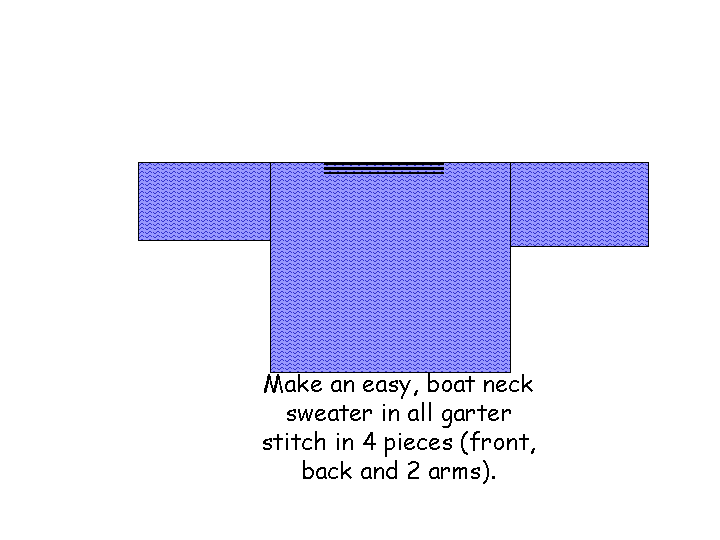
There are many free patterns for knitting bulky sweaters on both commercial and free websites. If you're knitting your first sweater, look for one similar to the picture above.  On the web, you'll find a number of beginner-level patterns that can be made in one weekend, using heavy yarn and big needles. So, not having great knitting skills is not an excuse for skipping this project.

My version of the easy-knit bulky sweater calls for all garter stitch (see drawing above). You don't even have to have a specific pattern. Just check any garter stitch pattern in your size that calLs for the size needles and the approximate yarn gauge you want to use.  Then, cast on the same number of stitches as mentioned in the pattern. From there, it's all straight stitching, no increases or decreases. Check with your own body that what you're making is the size and length you want. The sleeves will need to be loose so cast on a few more than you think you need and check the width to see your results after you've stitched a few rows.

Notes
- One of my variations on this simple sweater calls for using about three inches of seed stitch (also an easy stitch that's slightly tighter than garter) for the waist and the same for the sleeves at the wrist. Garter for the rest. I use the same number of stitches as I would for a pattern in all garter stitch and one number smaller needles only for the seed stitch rows.

- Just as a warning, many factory-made sweaters that you’ll find are made from thinner or finer yarns, and unraveling them won’t be simple. If you find a sweater with interesting yarn, look at it carefully. Check the texture and weight of the yarn to see whether or not it can be taken apart easily. I've had some bad moments trying to take apart sweaters that had fine yarns. It's possible, of course, but you have to be very patient to do it.